Dance of the Cavalry Fan Yat Long
This piece is inspired by the poem “Po Zhen Zi” by Xin Qiji, a patriotic poet from the Southern Song dynasty. This poem reflects both his fervent longing for restoring national unity and the quiet sorrow of unfulfilled ambition. It mirrors the struggles of many young people today who are full of ideals yet worn down by various realities and sometimes retreating into passivity. Through this piece, listeners are gently reminded to treat themselves with kindness.
This piece unfolds in five movements:
Prelude, “Drunken Dream”: Introduced by guzheng and dizi, the protagonist, lost in drink, recalls the mournful calls of military horns under the dim nightlight.
The second movement, “Camp Recollections”: Plucked timbre extends the echo of bugle calls in the camp to a distant dreamscape, gradually painting the vastness of the battlefield.
The third movement, “Battle Cries”: An intense allegro with a vigorous, fast-paced movement that depicts the magnificent scene of soldiers charging into war. Its driving rhythms lay the groundwork for what follows.
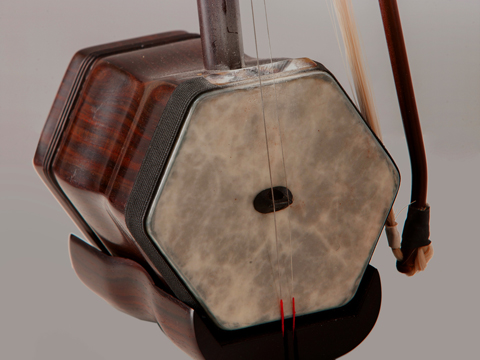
The fourth movement, “Strings and Fire”: Interwoven erhu and dizi lines, accompanied by percussion, evoke galloping cavalry and the sharp flight of arrows, showcasing the grandeur and intensity of the army.
Finale, “Awakening”: Echoing the prelude in its melody, the music reflects the protagonist’s longing for glory yet lamented by the passage of time. The piece ends with a poignant contrast between dream and reality.
The Leaping Journey Yau Wing Gap
“Leap” suggests an ascent, a bound forward motion. “Journey” speaks of passage and distance. Through the four sections of the piece, including Departure, Thoughts, Clarity, and Aspiration, it expresses not only a musical voyage but also a map of the inner self, drawn in musical notes.
It does not tell you where to go.
Instead, it faithfully records
every leap,
every pause,
every turning thought
and every moment when, carrying the weight of lived experience,
you still choose to leap again.
Departure: A new journey begins, poised and full of anticipation. The light and lively melody of the plucked instruments and forward-moving rhythms pulse like a beating heart.
Thoughts: Thoughts drift endlessly, wandering beyond control. Chromatic lines in the strings echo the murmurs of the mind, full of uncertainty, hesitance and indecisiveness.
Clarity: Clear understanding, a clear and lucid thought from subtle fluctuations of inner emotions. With the dizi’s variation lingering as the upper register, and yangqin’s repeating melodies adding to the momentum, implying a new progress in the matter.
Aspiration: At last, the purpose is found and the goals are set. With unwavering conviction, the journey continues towards its dreams. The recapitulation returns to the beginning, with an enriched texture, ready to embrace what lies ahead. In the last three bars, zhongruan recalls the melody from the opening, as a reminder to preserve a precious childlike heart even in the pursuit of breakthroughs.
Cry of the Wall Huon Ka Shun
Last summer, I visited the Mutianyu Great Wall in Beijing. Walking along its ancient stones, I was reminded of a play I had seen many years ago — “Lady Meng Jiang’s Bitter Weeping”. Its plot is roughly as follows:
In the Qin dynasty, Lady Meng Jiang was newlywed when her husband was conscripted to build the Great Wall. Fearing the bitter northern cold, she traveled thousands of miles to bring him winter clothes, only to discover that he succumbed to the cold and died. To make things worse, the Great Wall was built upon his burial ground due to a policy change. Lady Meng Jiang wept upon the Great Wall. Perhaps heaven was moved by her actions, a section of the Wall collapsed, revealing her husband’s remains. Ultimately, Lady Meng Jiang’s wish came true, and she was reunited with her husband for eternity.
This composition draws upon impressions of the play and is divided into six sections:
The opening serves as a prelude, inspired by the Cantonese opera “Yat Gam Jeui,” evoking the essence of traditional opera. The minor key tone establishes a mood of quiet sorrow.The second section turns sweet and affectionate, portraying the couple’s happy life after their marriage, until the sudden call of horns signals the arrival of soldiers.
The third section develops a melody from the prelude into a marching theme for the army. Accumulated resentment is released through the wailing suona, only to be suppressed again and again, until it erupts into conflict between the people and the government. A final roar marks both an ultimate blow and the husband’s departure. Lastly, the army marches away, leaving the wife alone.
A new musical language emerges in the fourth section, symbolizing the wife’s long and desperate journey to the Great Wall. Rapid passages and shifting tonalities reflect her anxiety and disorientation. The rapid stacking of chromatic scales ultimately carries her, at last, to the Great Wall.
The fifth section, the celebratory section, uses a melody from the prelude to express her emotions when her grief reveals her husband’s remains at the Great Wall. The addition of resonant gong patterns in repetition drives the emotion to another climax.
The coda weaves together fragments of melodies and rhythms from the first five sections, with percussive echoes bringing the work full circle, concluding the entire piece.
Postwar Home Choi Tsun Kin
Postwar Home tells the story of a small town in the aftermath of war, centering on a young girl’s profound grief for the loss of her father.
The opening paints a serene landscape of the town, gentle hills, flowing rivers, and warm sunlight. Eight bars later, a relaxed and peaceful life in the town emerges. After another eight bars, the dialogue between the xiaoruan and Glockenspiel, set against the orchestra, suggests conversations among the residents.
Then, the alto sheng introduces a fifth harmony, imitating the sound of horns, signaling an omen of war.
At the 30th bar, the melody from Dies Irae by Beethoven appears, the melody that is often used in films to foreshadow death, preparing the audience for what is to come.
After the war, peace returns, but the girl receives news of her father’s death. The gaohu takes her voice, as if speaking into the empty air from the attic of her home. Harmonies and bass lines join later and deepen the emotional weight.
In the end, steady strokes in the strings accompany her reluctant farewell, as she attends her father’s funeral with tears she cannot hold back.
The piece concludes abruptly, leaving the audience behind with a lingering sense of loss.
The Journey Ma Hong Yiu
Life itself is a journey.
“Mountains”: A powerful opening, captures the grandeur of mountains with drumbeats and a firm rhythm, with a theme and sub-theme rising and falling with intensity
Majesty is encountered along the journey.
“Lakes”: Clear and tranquil, the vibrato of the strings is like rippling water. Then the sheng introduces the melody that builds towards the climax, a lyrical and flowing form.
Tranquility of water filled the journey.
“Sunset Glow”: A pointillist texture sketches a sunset scene. There is always a touch of reluctance at such a scene during a journey. However, a swing rhythm then brings the whole piece to an end. The theme returns, like a joyful farewell at the end of the journey.
This piece is dedicated to all my companions of the August 2025 journey to Australia.